Ledesma (active 1602–1614) is not just another Baroque painter; he is one of the first recorded practitioners of the Bodegón (Spanish still life). To own a Ledesma is to possess a part of the very beginning of a tradition that would eventually give rise to masters such as Velázquez and Zurbárán.
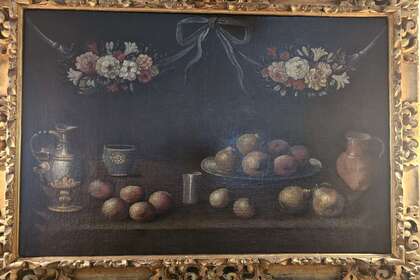
This stunning 17th-century Spanish Still Life, attributed to the circle of Blas de Ledesma, epitomizes the rigid elegance and theatricality of the early Baroque. The composition, centred on a finely chiseled silver vase or ewer of mannerist design, is framed by a symmetrical festoon of vibrant flowers—including roses and bluebells—and heavy clusters of ripe grapes hanging suspended by a characteristic blue ribbon. Painted on a thick weave canvas typical of the period, the work uses a dramatic dark background to highlight the detailed textures of fruit and metal towards the foreground, creating a deep sense of three-dimensionality. The meticulous arrangement on a cold stone parapet reflects the still life philosophy of the Granada school, offering a timeless meditation on abundance, luxury and the ephemeral nature of beauty.



 +34 631434350